Fuel Cycles
The Growing Importance of Supporting Systems
While much of the attention in nuclear fusion has long been focused on core systems, such as plasma physics and magnetic confinement, there is now a clear shift: fuel cycle management is increasing strategic relevance.
Many of the key technical challenges in stellarators, tokamaks, and other fusion concepts have been addressed. Record-breaking results in plasma uptime and Q-values (efficiency and energy gain) demonstrate the progress made in core technologies. But one essential aspect has remained in the background for too long: how is the fuel itself managed?
Real-Time Measurements
Fusion reactors will predominantly use protium or deuterium-tritium (D-T) fuel mixtures. In the case of tritium, the fuel must be generated inside the reactor by harvesting neutrons from lithium-6. Once bred, the gas must be extracted from the reactor along with fusion byproducts, such as helium-3 (³He) and traces of other elements. It then needs to be cleaned, stored, re-mixed, and re-injected into the plasma.
Depending on the reactor design, the burn-up rate may range between 1–20%, meaning a significant share of the tritium inventory remains in circulation within the fuel loop. For both cost and safety reasons, the goal is to keep this circulating inventory as low as possible, while maintaining sufficient reserves to ensure stable operation.
This highly dynamic process requires real-time analytics. The gas composition must be continuously measured and controlled. Depending on system architecture, the pressure within the fuel loop is in a high vacuum of approximately 10 bar, making analytical precision across conditions essential.
Enabling a Closed Control Loop
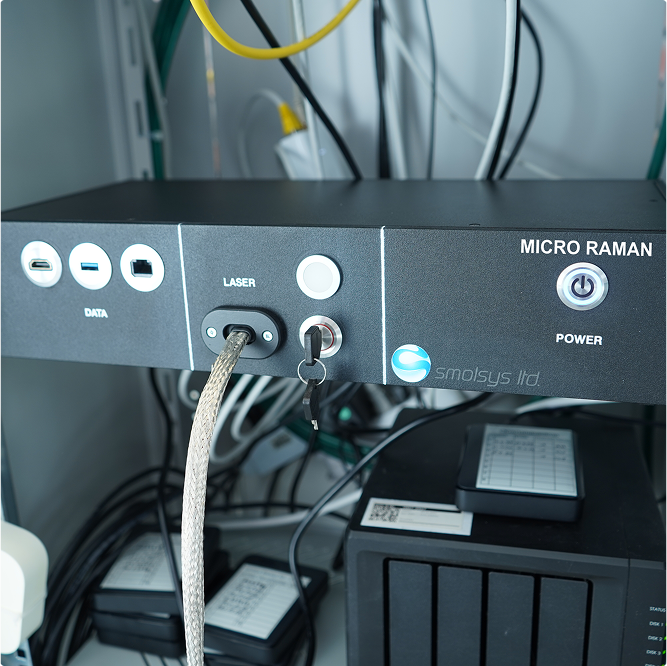
A breakthrough solution developed by the Tritium Laboratory at Karlsruhe Institute of Technology (KIT) and now exclusively licensed to smolsys, offers a new level of capability in real-time fuel cycle analytics: the Micro Raman Spectrometer.
This compact “Micro Raman” inline device provides real-time isotopologue differentiation of all six relevant hydrogen pairs (H₂, D₂, T₂, HD, HT, DT), as well as nitrogen detection. It has been successfully deployed in the KATRIN project, currently the world’s largest civilian tritium fuel cycle (40 g turnover of tritium per day), where it operates under varying pressure conditions with sampling intervals measured in seconds and without the need for low-pressure bypasses.
Designed as a Plug & Produce solution, the Micro Raman system delivers actionable data with just three clicks. Its intuitive interface and robust performance make it suitable for industrial environments.
For extended applications, it can be paired with a solid scintillation–based glow sensor, enabling quantification of hydrogen isotopologues even in complex multi-gas mixtures.
Together, these tools enable the automation of a closed control loop in the fuel cycle. This is an essential step toward stable plasma and reactor systems. Without precise, real-time analytics, fluctuations in fuel composition can shorten system lifetime and lead to significant operational costs.
Supporting the Fuel Cycle Infrastructure
Whether for fusion fuel cycle management, research systems, automation, or analytical integration – smolsys provides the infrastructure required for the next generation of fusion systems.
smolsys – the tritium equipment one-stop shop, with its own licensed tritium facility and decades of hands-on expertise.

Design amazing digital experiences that create more happy in the world.